

Introduction
Merzouga lies roughly 560 kilometres from Marrakech, an 8 to 10 hour drive over the Tizi n'Tichka pass and through the pre-Saharan south. Most travellers cover it on a guided tour, though the Supratours bus and self-drive both work. Plan at least three days: two is possible on paper, but you will spend nearly all of it in a vehicle.
How far is Merzouga from Marrakech?
Merzouga sits about 560 kilometres (roughly 350 miles) south-east of Marrakech. Driving it takes 8 to 10 hours depending on your stops, the season, and conditions on the mountain passes.
That number surprises people. On a map the Sahara looks like a day trip from Marrakech. It is not. The road climbs over the High Atlas, winds through gorges, and crosses the pre-Saharan plateau before the dunes appear. The distance is not the hard part — the terrain is.
Merzouga itself is the village at the edge of Erg Chebbi, the dune sea most travellers picture when they imagine the Moroccan Sahara. The dunes rise straight out of flat, stony desert, which is exactly why they look the way they do in photographs.
How many days do you need?
Allow three days minimum. Two-day trips exist, and the arithmetic is the problem: 16 to 20 hours of driving inside 48 hours leaves you almost no time out of the vehicle. You would reach the dunes at dusk and leave at dawn.
Three days is the standard, and it works: one long driving day south, a full day around the dunes and the desert villages, and the return. Four days is better if you want the gorges and kasbahs to be more than a photo stop.
If the desert is the reason you are coming to Morocco, build the itinerary around it rather than squeezing it in at the end. Travellers who try to bolt it onto the last two days of a trip almost always wish they had given it more room.
Option 1: a guided tour
This is how most travellers do it, and for good reason. The driving is long, the route is remote in stretches, and a driver who knows the road turns transit time into part of the trip. A guided tour also handles the desert camp, the camel trek timing, and the stops along the way — the parts that are awkward to arrange yourself from abroad. It removes the two things that go wrong most often: arriving somewhere after dark, and booking a camp that turns out to be nothing like its photographs. The trade-off is flexibility. You follow a set route and schedule. Shared tours also mean travelling at the group's pace, which cuts both ways. A private tour costs more but lets you linger where you want and skip what does not interest you.
Option 2: the Supratours bus
Supratours runs a daily service from Marrakech to Merzouga. It is the cheapest way to reach the dunes and a solid choice if you are travelling solo or on a tight budget. The honest trade-off: the bus goes from A to B. You will not stop at Ait Ben Haddou, you will not see the gorges, and you arrive needing to arrange your own camp and camel trek locally. Many travellers do exactly that and have a fine time — camps in Merzouga are used to walk-in bookings. What it costs you is the route itself, which is a genuine part of the experience rather than filler. And it costs you time: you spend the same hours in a seat, without the stops that break them up. Check current timetables and fares directly with Supratours before you plan around them — schedules change with the season.
Option 3: driving yourself
The drive is around 9 hours without stops, on roads that are paved and in reasonable condition the whole way. A rental car gives you the freedom to stop where you like and stay as long as you want, which suits the route well. What to weigh: the Tizi n'Tichka is a long mountain pass with sustained switchbacks, and it demands attention. Driving it after a long-haul flight, or finishing the final stretch in the dark, is where people get caught out. Start early — leaving Marrakech at first light changes the day completely. Fuel stations thin out south of Ouarzazate, so fill up when you can rather than when you need to. And plan to arrive in daylight: the final approach to Merzouga is easier to find before dusk. A private driver is the middle ground — your own schedule and stops, without you at the wheel for ten hours on unfamiliar mountain roads.
What you see along the route
The road south is not dead time. It is one of the best drives in Morocco.
You cross the Tizi n'Tichka, the highest major mountain pass in North Africa, as the High Atlas opens up around you. The landscape changes character every hour: green valleys, then bare rock, then the red earth of the south.
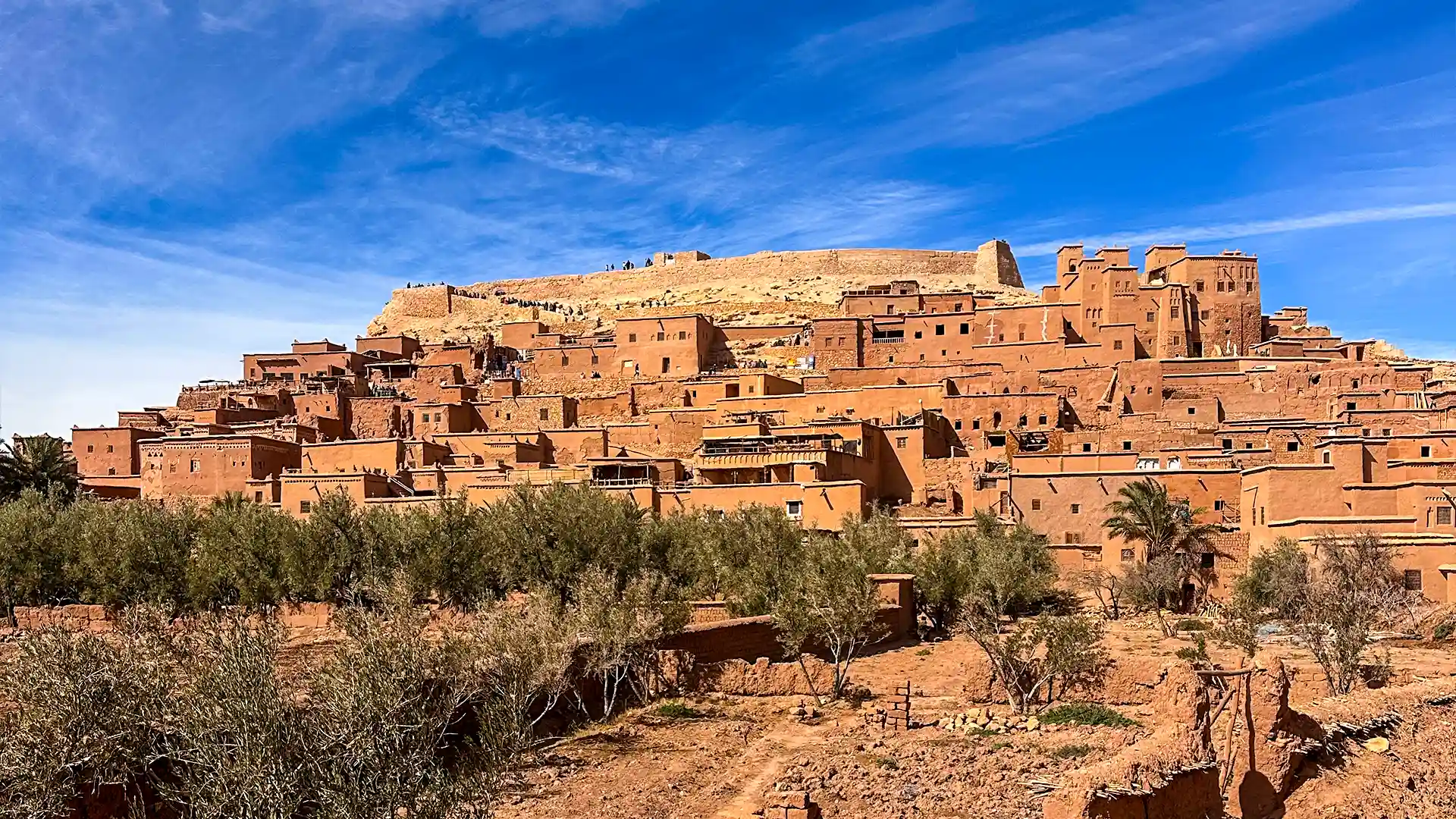
Beyond the pass lies Ouarzazate, the film-studio town that serves as the gateway to the south. A short detour away sits Ait Ben Haddou, the fortified ksar you have seen on screen more times than you realise — it has stood in for half the ancient world in films and television.
Further on, the Dades and Todra gorges cut deep red walls out of the rock, narrow enough in places that the road runs in permanent shade. Then the landscape flattens, the palm groves thin out, and the first dunes of Erg Chebbi rise out of nothing.
This is why the three-day version beats the two-day one. The route is the trip.
Merzouga, Zagora or Erg Chigaga: which desert?
Not all Moroccan desert is the same, and this is where trips go wrong. Travellers book the closest option and arrive expecting the Sahara of the photographs. Merzouga (Erg Chebbi) is the classic. Tall dunes, the full dune-sea landscape, and the shortest walk from a road to something genuinely spectacular. It is the furthest of the three from Marrakech, and that distance is the price of the view. Zagora is closer and fits a two-day trip, which is exactly why it is sold so often. Its dunes are modest. Travellers who arrive expecting Erg Chebbi are routinely disappointed by the scale — this is the single most common complaint about Moroccan desert tours. Erg Chigaga is the wild card: remote, dramatic, and far less visited. Reaching it means driving to M'Hamid and then continuing roughly an hour and a half by 4x4 across open desert. It rewards the effort, but it takes more of it. If towering dunes are your reason for coming to Morocco, go to Merzouga and give it the days it needs.
Coming from Fez instead
Merzouga is not only a Marrakech trip. From Fez the drive is roughly 7 to 8 hours via Midelt and Erfoud — shorter than from Marrakech, and the most direct approach to the dunes. This opens up the itinerary most people should be doing anyway: enter at one end, exit at the other. Fly into one city, cross to the desert, and continue to the other rather than backtracking. You cover the country once instead of driving the same roads twice. The Marrakech approach gives you the Tizi n'Tichka, Ait Ben Haddou and the gorges. The Fez approach is faster and passes through the Middle Atlas cedar country and the Ziz valley. Doing one in each direction is the strongest version of the trip, and it is why the longer imperial-cities-and-desert routes are shaped the way they are.
Desert camps: what to expect
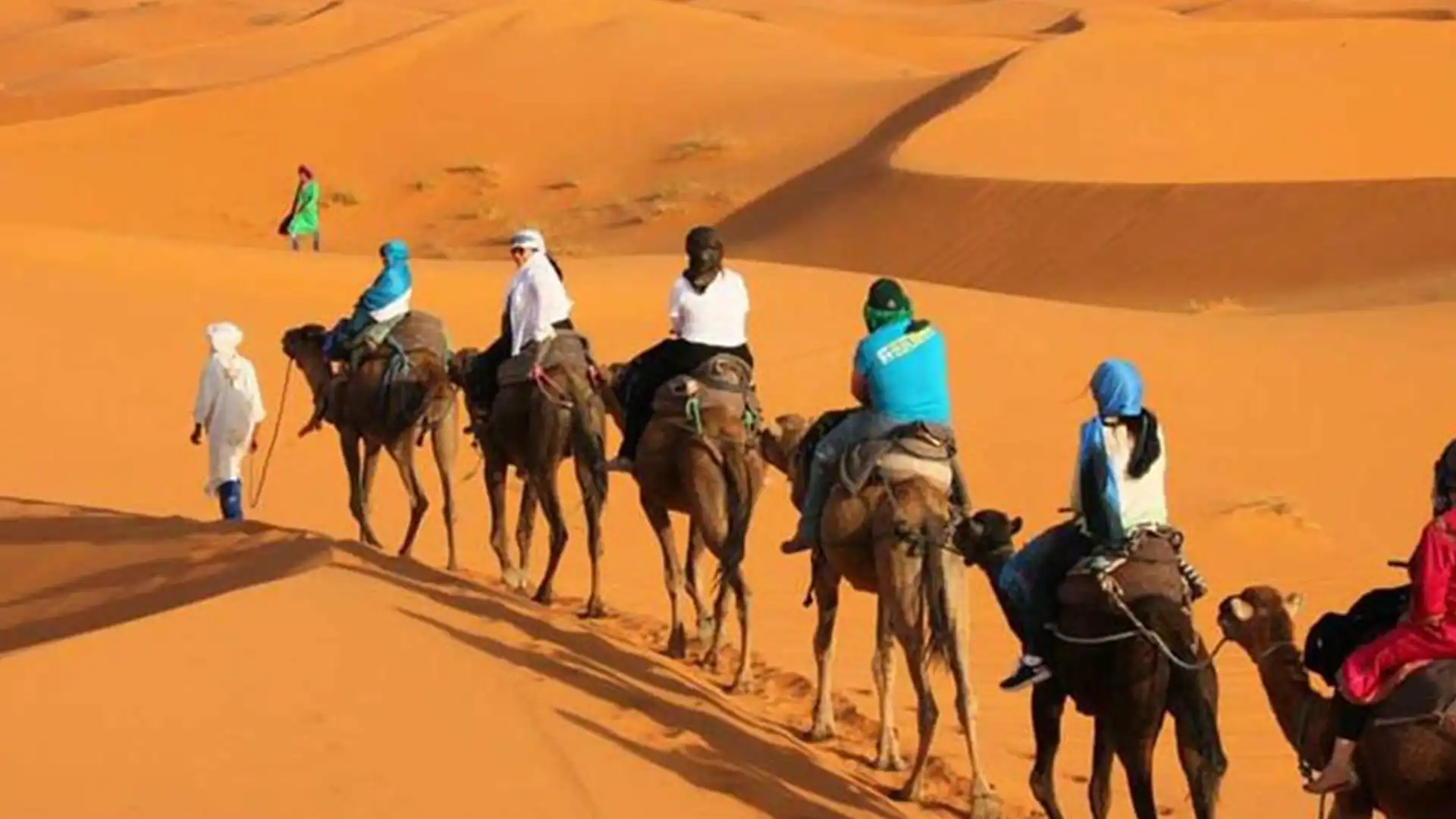
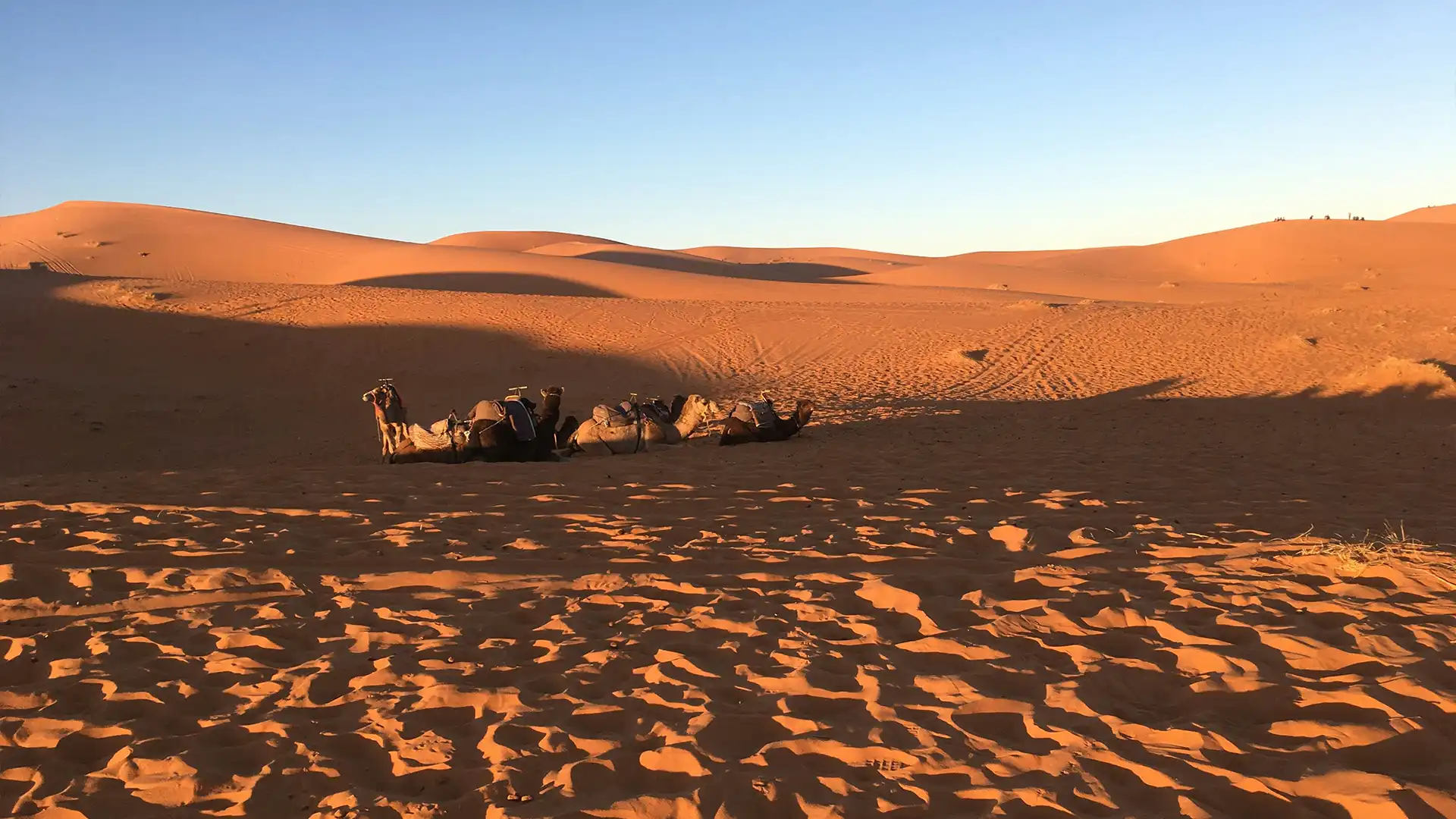
Camps at Erg Chebbi range from simple tents with shared facilities to permanent luxury camps with private bathrooms and proper beds. Most include dinner, breakfast, and a camel trek out to the dunes for sunset or sunrise. Nights in the desert are colder than people expect, in every season. In winter they are genuinely cold. Bring layers regardless of what the daytime forecast says — this is the most common packing mistake on this trip. The camel trek is usually an hour or so each way. If that does not appeal, or if you have back or mobility concerns, most camps can arrange a 4x4 transfer to the camp instead. Worth asking when you book rather than discovering the options on arrival. One detail that matters more than the tent: how far the camp sits from the road. The deeper camps are quieter and darker, which is the entire point of sleeping in a dune sea.
The best time of year for the desert
Spring and autumn are the sweet spots: warm days, cold nights, and manageable conditions on the dunes.
Summer in the Sahara is severe. Daytime heat makes the middle of the day unusable, and the long drive south is punishing. It is doable, and people do it, but it is not the trip most travellers are picturing.
Winter brings clear skies and comfortable days, with genuinely cold nights and the possibility of snow on the Tizi n'Tichka pass, which can affect the route. Check conditions before setting out between December and February.
What to pack for the desert leg
Layers, first and last. Desert days and desert nights are two different climates, and the gap between them catches people out year-round. Bring something warm for the evening even in summer — a fleece or jacket you would not think to pack for Marrakech. Add sun protection you can actually rely on across long exposed hours: hat, sunglasses, high-factor sunscreen. Closed shoes matter more than sandals once you are walking on dunes, and a scarf earns its place: sun, wind and blown sand all make it useful rather than decorative. A power bank is worth having. Camps run on generators or solar, and charging is often limited to set hours. Cash is worth having too, for the same reason ATMs are not a feature of the dunes.
Frequently asked questions
You can drive it in one day — 8 to 10 hours — but you would arrive at night and see nothing of the route. It is not a day trip and cannot be done as a return in a day.
It is paved and in reasonable condition throughout. The demanding part is the Tizi n'Tichka pass: long, winding, and tiring rather than dangerous.
Not for the drive itself. A standard car reaches Merzouga fine. A 4x4 is only needed off-road in the dunes, which camps and tour operators handle.
Zagora is closer to Marrakech and fits a shorter trip, but its dunes are small. Merzouga's Erg Chebbi is the tall dune sea people come for. If the Sahara is your priority, the extra distance is the point.
Fez, at roughly 7 to 8 hours against 8 to 10 from Marrakech. Many travellers arrive from one city and leave towards the other.